महाभारत · Mahabharata text
The Mahabharata: Introduction, Epic Summary, and Core Teachings
Explore the Mahabharata, the greatest epic of Sanatan Dharma. Learn about the story of the Pandavas and Kauravas, the Kurukshetra War, and the profound teachings of Dharma.
Sage Krishna Dvaipayana Vyasa (Traditionally scribed by Lord Ganesha)July 9, 2026 61 views English
Available in:
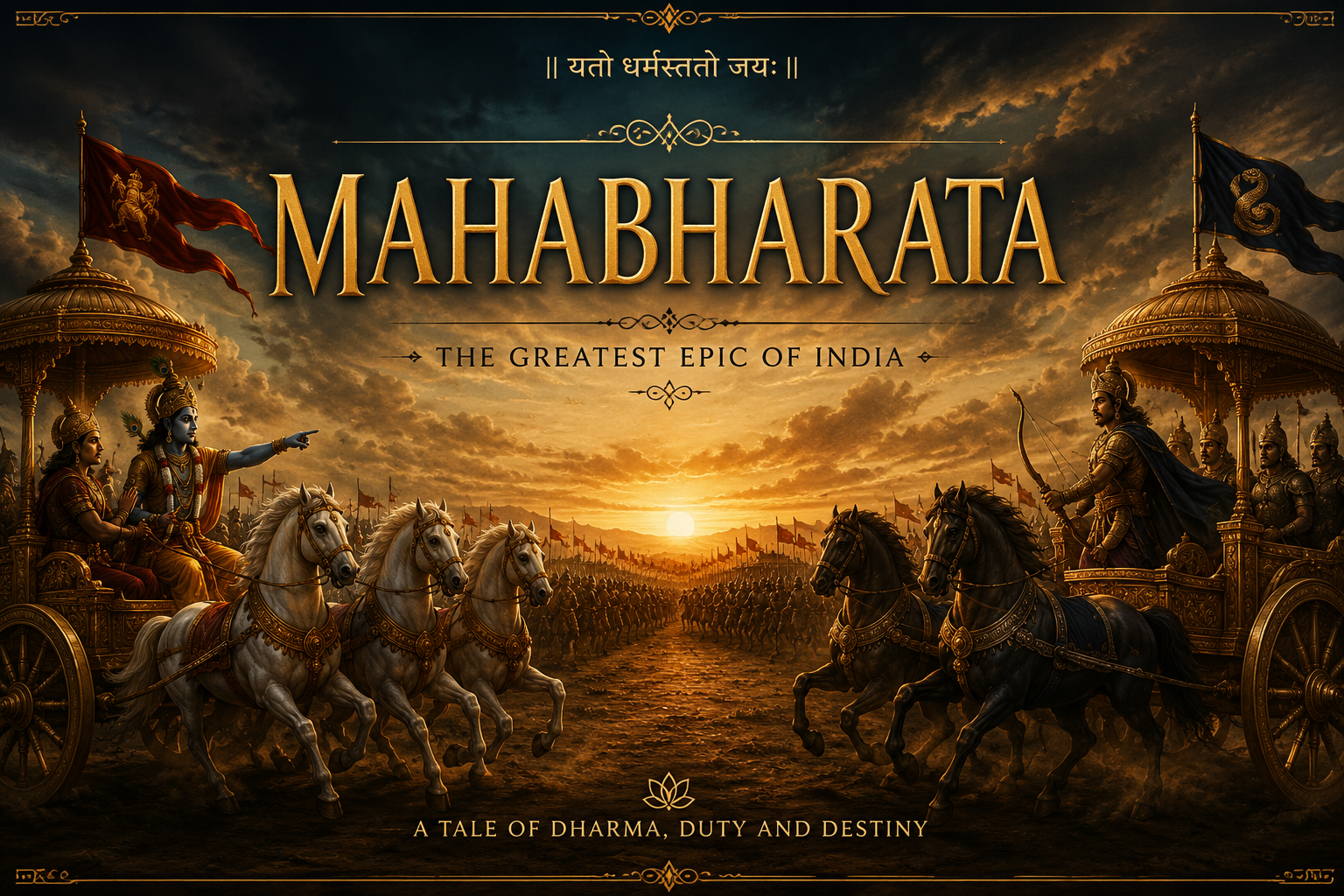
The Mahabharata is one of the two major Sanskrit epics of ancient India (the other being the Ramayana). Categorized as "Itihasa" (meaning "thus it happened" or history), it was traditionally compiled by the great Sage Krishna Dvaipayana Vyasa.

With over 100,000 shlokas (verses) divided into 18 Parvas (books), it is the longest epic poem ever written in human history—roughly ten times the length of the Iliad and the Odyssey combined. However, the Mahabharata is not just a historical story of a great war; it is a profound philosophical and spiritual encyclopedia exploring the deepest concepts of human life, duty, morality, and ultimate liberation.

---
THE CORE STORY: PANDAVAS VS. KAURAVAS

At its surface, the Mahabharata is the story of a dynastic struggle for the throne of Hastinapura, the kingdom ruled by the Kuru clan. The conflict arises between two collateral branches of the family:

• The Kauravas: The hundred sons of the blind King Dhritarashtra, led by the ambitious and envious eldest brother, Duryodhana.
• The Pandavas: The five acknowledged sons of Pandu (Yudhishthira, Bhima, Arjuna, Nakula, and Sahadeva), who were fathered by various gods and are the rightful heirs to the throne.

Driven by jealousy and greed, the Kauravas repeatedly try to destroy the Pandavas, most notably through a rigged game of dice that results in the Pandavas being exiled to the forest for 13 years. When the Pandavas return and peacefully ask for just five villages to rule, Duryodhana refuses to give them even "a needlepoint of land." This arrogant refusal makes the great war inevitable.

---
THE KURUKSHETRA WAR

The climax of the epic is the devastating Kurukshetra War, which lasts for 18 days. It is a world war of the ancient era, drawing kings and armies from across the Indian subcontinent and beyond.

Lord Krishna, an avatar of Lord Vishnu, plays a central role in the epic. Refusing to bear arms himself, he agrees to serve as the non-combatant charioteer and divine guide for Arjuna, the greatest archer of the Pandavas. The war ends with the victory of the Pandavas, but at an unimaginable cost. The epic does not glorify war; instead, it showcases the tragic, sorrowful aftermath of conflict, even when fought for the right reasons.

---
THE JEWEL OF THE EPIC: THE BHAGAVAD GITA

The most famous and sacred section of the Mahabharata occurs just as the Kurukshetra War is about to begin. This section is known as the Bhagavad Gita (The Song of God).

Seeing his own grandfather, teachers, and cousins lined up on the opposing side, Arjuna breaks down, drops his weapons, and refuses to fight, questioning the morality of killing his own blood. In response, Lord Krishna pauses time and delivers a supreme spiritual discourse.

Krishna teaches Arjuna about:
• Dharma (Righteous Duty): The necessity of performing one's duty without attachment to the outcome.
• Atman (The Soul): The eternal, indestructible nature of the soul, which cannot be killed by any weapon.
• Yoga: The various paths to ultimate liberation, including Karma Yoga (action), Bhakti Yoga (devotion), and Jnana Yoga (knowledge).

---
THE CORE THEMES

1. Dharma (Righteousness)
The central pillar of the Mahabharata is Dharma. The epic constantly explores the complexities of doing the right thing in morally grey situations. It teaches that "Dharmo rakshati rakshitah" (Dharma protects those who protect it).

2. Karma (Action and Consequence)
The epic intricately demonstrates how every action, good or bad, carries inevitable consequences that shape a person's destiny across lifetimes.

3. Time (Kala)
The Mahabharata portrays Time as the ultimate destroyer and creator, a supreme force that eventually levels all human pride, power, and empires.

---
CONCLUSION

As the epic itself boldly declares:
"Whatever is found here, may be found elsewhere. But what is not found here, is found nowhere else."
The Mahabharata is a complete mirror of human psychology, exploring every emotion, virtue, and flaw, ultimately guiding the soul toward spiritual enlightenment.