मन्दिर · Temples text
Badrinath Dham: The Supreme Himalayan Abode of Lord Vishnu
The ultimate guide to Badrinath Dham, the most prominent of the Char Dhams. Explore its ancient origins, the legend of Nar-Narayan, the Tapt Kund, and the mystery of the 6-month Akhand Jyoti.
Skanda Purana / Teachings of Adi ShankaracharyaAugust 5, 2026 38 views Sanskrit
Available in:
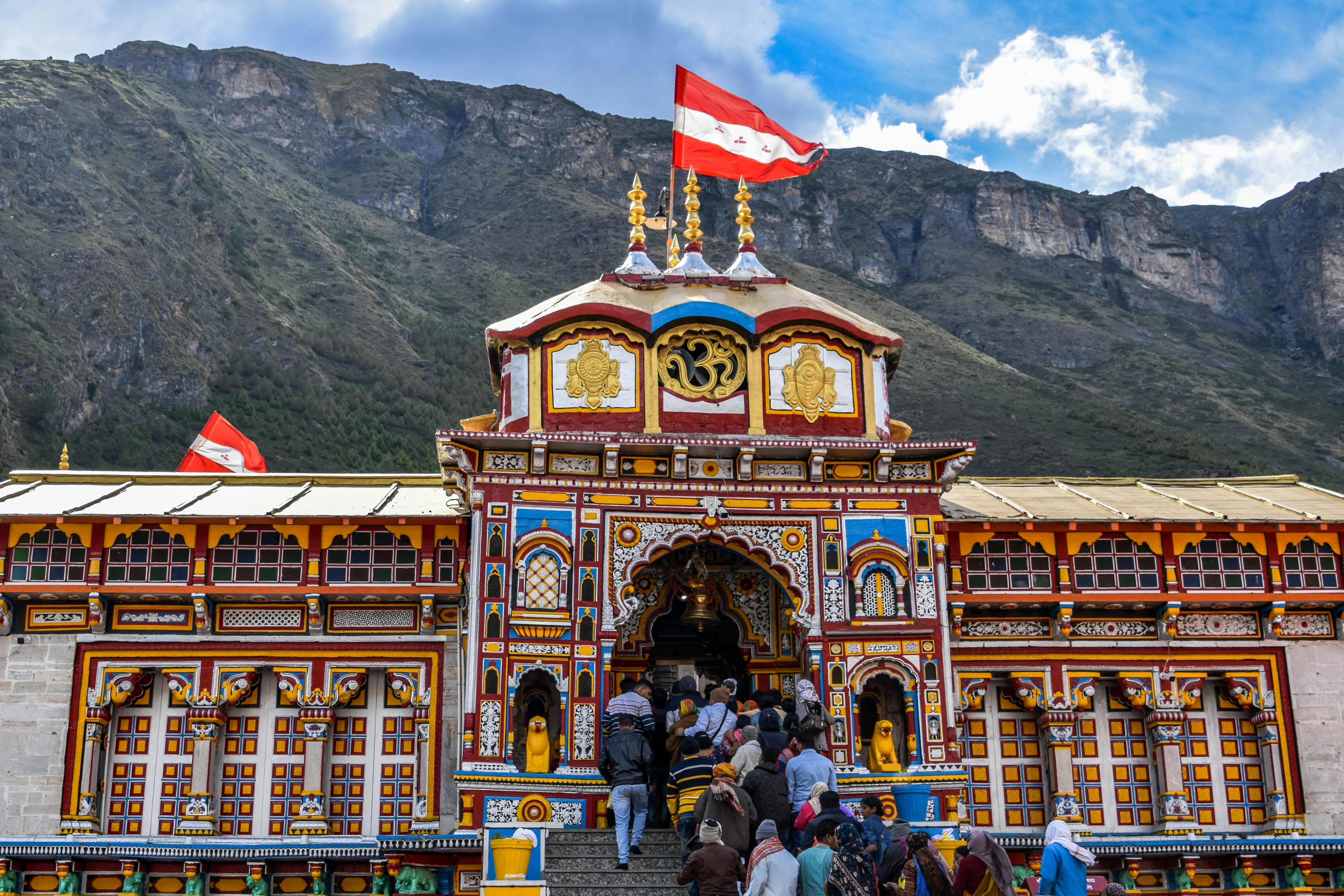
Nestled deep in the Garhwal Himalayas of Uttarakhand, at a breathtaking elevation of 10,279 feet (3,133 meters), stands the magnificent Badrinath Temple. Flanked by the towering Nar and Narayan mountain ranges and sitting on the banks of the roaring Alaknanda River, it is arguably the most highly venerated pilgrimage site for Hindus.

Badrinath holds a unique distinction: it is the only temple that is part of both the major "Char Dham" (the four cardinal pilgrimage sites of India) and the "Chota Char Dham" (the four sacred Himalayan shrines). It is revered as the earthly realm where Lord Vishnu resides in eternal meditation.

---
THE LEGEND OF ORIGIN (STHALA PURANA)

The name "Badrinath" comes from the word "Badri," which means jujube (Indian date) tree.

According to the Skanda Purana, Lord Vishnu came to these freezing Himalayan heights to perform intense, uninterrupted meditation (Tapasya). As he sat in deep trance, the weather turned severe, with freezing winds and heavy snowfall. To protect her husband from the harsh elements, Goddess Lakshmi miraculously transformed herself into a massive Badri tree, spreading her branches over Him like a protective umbrella.

Pleased by her supreme devotion, Lord Vishnu declared that this sacred land would forever be named after her act of love. Hence, the place became known as "Badrika-Ashram," and He became "Badrinath" (The Lord of the Badri).

---
THE ARCHITECTURE AND THE SWAYAMBHU IDOL

Unlike the massive stone complexes of South India, Badrinath features striking, brightly colored architecture suited for the Himalayas, resembling a Buddhist vihara (temple) with its vibrant facade and golden roof.

1. The Sanctum Sanctorum (Garbhagriha)
Inside the innermost chamber sits the supreme deity of Lord Badrinath. Unlike most temples where the idol is carved by humans, the idol of Badrinath is a 1-foot-tall black stone made of Saligram. It is "Swayambhu" (self-manifested). Lord Vishnu is depicted sitting in the Padmasana (lotus) posture, deep in meditation.

2. The Recovery by Adi Shankaracharya
In ancient times, Buddhist ascetics threw the sacred idol into the nearby Alaknanda river to protect it from invaders. In the 8th century, the great philosopher-saint Adi Shankaracharya had a divine vision. He dove into the freezing Narad Kund (a pool in the river) and miraculously recovered the original Saligram idol, installing it in the current temple.

---
UNIQUE SHRINES AND SACRED SECRETS

• Tapt Kund (The Boiling Spring): Just below the freezing temple steps lies a natural geothermal hot spring known as Tapt Kund. Despite being surrounded by snow, the water remains at a scorching 45°C (113°F). Devotees believe that Agni Dev (the fire god) resides in the water, and taking a dip here washes away lifetimes of sins before meeting the Lord.
• The Nambudiri Rawal: In a beautiful display of India's cultural unity established by Adi Shankaracharya, the chief priest (Rawal) of this Himalayan temple in the extreme North is always a Nambudiri Brahmin from Kerala in the extreme South.
• The Village of Mana: Located just 3 kilometers from Badrinath is Mana, the "Last Village of India." It is here that Sage Vyasa composed the Mahabharata, and the legendary Vyasa Gufa (cave) can still be visited today.

---
FESTIVALS AND RITUALS: THE 6-MONTH MYSTERY

Because of its extreme altitude, Badrinath is completely inaccessible during the winter. The temple remains open for only 6 months of the year (usually from Akshaya Tritiya in April/May to Bhai Dooj in November).

When the temple doors are closed for the winter, the priests light an oil lamp known as the "Akhand Jyoti" and leave behind offerings for the celestial beings (Devas). According to legend, the great sage Narada himself performs the worship of Badrinath during the 6 months the temple is sealed. Miraculously, when the priests return and unlock the doors half a year later, the Akhand Jyoti is still burning bright amidst the deadly winter snow!

---
CONCLUSION

Badrinath is the ultimate test of a pilgrim's faith. For centuries, saints, kings, and commoners walked barefoot for months through deadly mountain passes just to catch a glimpse of the Lord of Badri. Today, it remains a supreme spiritual magnet, proving that the harshest environments often hold the deepest peace.